DeBank Hi Whitepaper
Introduction
The missing piece of the web3 puzzle
Countless innovations are emerging from infrastructure to applications, as the Web3 industry evolves remarkably. Among them, web3 messaging, an indispensable service in this community, remains undefined.
What makes a message application web3-native
For a web3 messaging application, the following principles are obvious:
- Account system based on 0x addresses
- Open and permissionless
- Transparency and no privileges
An open communication network will inevitably face the challenge of flooding spam from day one. We have all witnessed this in all kinds of web2 message apps.
The traditional way of identifying and filtering spam by setting up countless rules can never solve the root of the issue. The fundamental reason for spam flooding is that user attention is not seen as an asset and reasonably priced as it should be.
What we are proposing here is defining user attention as an asset and establishing a market with reasonable pricing. This will put an end to scammers profiting from gaining user attention for free.
As the messaging network built on a basis of a market for attention, it will also have the following characteristics:
- Bots are equally treated
Although bot behaviors are often being accused of damaging normal users' experiences, it's never easy to block bots without the risk of centralization. Marking and blocking potential bot addresses is a privilege that no decentralized platform should have. Building an effective market for attention means everyone should pay the cost without distinction, including bots. So bots no longer need to be treated differently.
- Message receivers are compensated
Web2 users are constantly bombarded with information and advertisements. Centralized platforms take all the profit by selling users' attention. Trading user’s own attention allows them to take back the initiatives and get compensated for the time and energy spent.
DeBank Hi -- A Market for Attention
Attention as an asset
We define user attention paid to received messages as an inherently scarce asset. Every time usersreceive messages and open the app, entering the market for attention, the attention spent in the process can be symbolized as a simple asset.
However, it's worth mentioning that the attention spent after the process ofreading a particular messageis not included in the definition here. Different messages offer different values to attract receivers' attention, and thus the attention spent here can't be simply priced and traded.
The behavior of users opening the messaging app is considered minting an attention asset.
Trading the attention asset
After defining the attention asset, designing how it can be traded is rather simple:
Sending a message is placing an offer for the attention asset that hasn't been minted by the receiver. The receiver, also the provider of the attention asset, logs into the app and accepts the offer by reading the message. This behavior is equal to minting an attention asset and selling it, completing the trade.
A simple trading market only needs to achieve the function above. However, a frictionless and effective market requires mutual consensus for the pricing, which is difficult to achieve.
Learning from the success of AMM, transaction costs can be significantly reduced by utilizing a valid and automatically functioning pricing model.
Before introducing the pricing model for the attention asset, let's dive into this asset to reveal more of its characteristics.
Characteristic of the attention asset
Attention asset as an NFT
The attention provided by different users is not fungible. Furthermore, for the same user, each time he/she opens the app to mint an attention asset is also not fungible. It's reasonable to consider the attention asset as a form of NFT.
How are NFTs issued?
The attention minted by the same user has a coherent and consistent basic value and therefore can be seen as a collection.
Every time the same user opens the app, a new NFT from the same collection is minted.
Supply and demand
Before the message receiver opens the app to mint the Attention NFT, the buyers first place offers to bid for the NFT by sending messages. The receiver logs into the app, and gives attention to all the messages, receiving the sum of all offers as the final price of the Attention NFT.
As attention is not an unlimited resource that has infinite supply, once the demand reaches a certain amount, the attention for each demand can not be guaranteed as valuable as usual. Hence, the bidding price for the supply will rise exponentially as demand rises. This will prevent the attention gained by each message from not being valid.
Attention Asset Pricing Model
Offer Price Curve
When placing an offer for the attention of the target (seller), the price for sending the 'nth' message:
a is the price of the first offer set by the seller.
b is a system parameter, reflecting how fast the price will rise as demand increases. When b=10, the offer price doubles whenever the offers increase by 10.
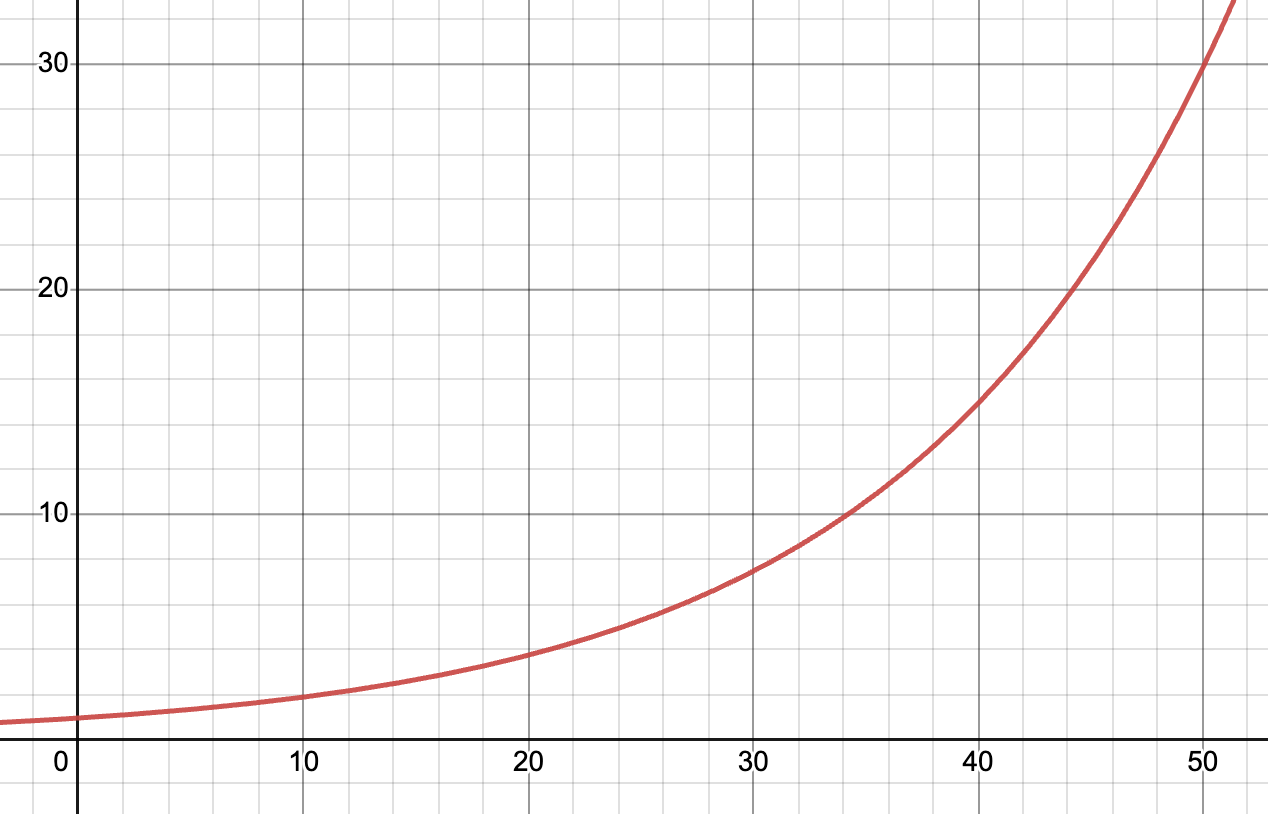
Offer price curve when a=1, b=10
Attention NFT Price
Thus, when a user mints the Attention NFT, the final NFT price is:
n is the total offers received for the Attention NFT
Summary
As a message application, what DeBank Hi aims to achieve are:
Define user attention as a form of NFT
Design a market for Attention NFT, enabling asset trading and communication
Introduce an automated pricing model for Attention NFT to reduce friction and increase trading efficiency, allowing a faster communication network.